
Where is my order?
The largest single category of contacts in most stores, and the one least worth a person’s time.
A shopper with an unanswered question does not email you. They close the tab, and you never learn what stopped them.
Traffic that browses and leaves, and a support inbox full of "where is my order".
is the tan one still available in a 40
Yes, two left in 40. Runs slightly narrow, so if you are between sizes the 41 is the safer pick.
checked live stock, then answered the question behind the questionand if it doesn’t fit?
Fourteen days to return it, unworn, and we send a label. Shall I put the 41 in your basket instead?
quoted your published policy, then closedNot a category list. These are the messages that arrive, and the reason each one is harder than it looks.
Where is my order?
The largest single category of contacts in most stores, and the one least worth a person’s time.
Will this fit me?
A sizing question is a purchase decision. Left unanswered it becomes an abandoned basket or a return.
How much is delivery, and when would it arrive?
Two facts that live in two different places, which is why people ask rather than look.
Can I return it if it is wrong?
Asked before buying far more often than after. It is a sales question.
Is this back in stock?
Answerable only against live stock. A cached page turns this into a cancelled order.
What is the difference between these two?
The comparison that decides the basket, and the one a product page never quite answers.
Does my code still work?
Small, constant, and entirely mechanical.
Most shopping happens after work, which is after your support team has finished.
Nobody freeOrder-status questions arrive in a wave, whatever the tracking page says.
Enquiry volume rises with traffic, and the questions get more urgent because the price is about to change.
Nobody freePeak trading multiplies every category of contact at exactly the moment nobody can be spared to answer.
Nobody freeThe most common message you get, handled in the conversation, so it never becomes a ticket and nobody logs in to look something up.
Answers where the order isYour catalog syncs rather than being read once, so nothing it recommends has already sold. Suggesting a sold-out item is worse than suggesting nothing.
Your store, connectedWhat is the difference, which lasts longer, which suits this. These are answerable from what you already publish, and answering them is the sale.
Finds the right productA customer sends a picture of what they want. The agent finds the nearest thing you stock, which is how people actually shop on Instagram.
Search by photoEvery trade has a line an agent must not cross, and the reason is usually law, insurance or a licence rather than good manners. This is configured before anything else.
It repeats the courier’s estimate and says it is an estimate. A date it made up becomes a complaint, a refund request and a review.
That is a commercial judgement with money attached, and it stays yours. The agent captures everything needed so the decision takes a minute rather than an exchange of emails.
Selling an item you cannot ship costs you the order and the customer. Live stock is the whole point of syncing the catalog rather than crawling it.
Every row is a job somebody does today. The bar is counted from the rows, so it says exactly as much as the table does and no more.
Everything listed is live today. See the full list.
Your CX Agent, set up for a storefront.
An AI agent that knows your live catalog: recommends, answers spec questions, takes the order and tracks it afterwards.
See Store Agent→Each of these is something a customer of yours gets, rather than a feature you switch on. Where it comes from is marked, so you can see what arrives with the agent and what needs a channel or your store connected.
product_finder Tool call Called on a vague request. It turns an occasion and a budget into a short list from what is actually in stock. Turns "something for a wedding under 8,000" into two or three real options instead of a search result page. capture_order Tool call Called once the customer has decided. It collects the items, the delivery details and the contact, then writes the order rather than handing over a form. Finishes the sale inside the conversation rather than sending someone to a form they will not fill in. track_order Tool call Called on any "where is it" message. It identifies the order and reports the carrier status rather than guessing a date. Handles the most common message you get without anybody opening the admin panel. visual_search Tool call Called when an image arrives. It matches the photo against your catalog and returns the nearest thing you sell. A customer sends a picture of what they want and gets the nearest thing you sell. store sync Connection Pulls products, prices and stock on a schedule. The reason an answer about availability is current rather than the state of a page last month. Products, prices and stock stay current, so an answer is never based on a page from last month. No. One live store on this runs more than eleven hundred pieces with prices synced, and the size of the catalog is the reason an agent beats a search box rather than a reason against it.
Yes, as the same agent with the same catalog. A customer who sends a photo in a DM gets the nearest thing you actually stock.
Only if you tell it a discount exists. It will not invent one, and it cannot approve a goodwill gesture. Those stay with you.
It answers in the language the message arrived in, across 95 or more, with no separate deployment and no translated site.
Paste the store URL and it trains on your own catalog and pages. Most stores are answering real questions the same day.
Paste your URL and OU Chat trains on your own pages, so the first answers it gives are about your business rather than a template. Seven days without a card, $29/mo after that, and a full refund on any plan within 30 days if it is not right.
Build your agent→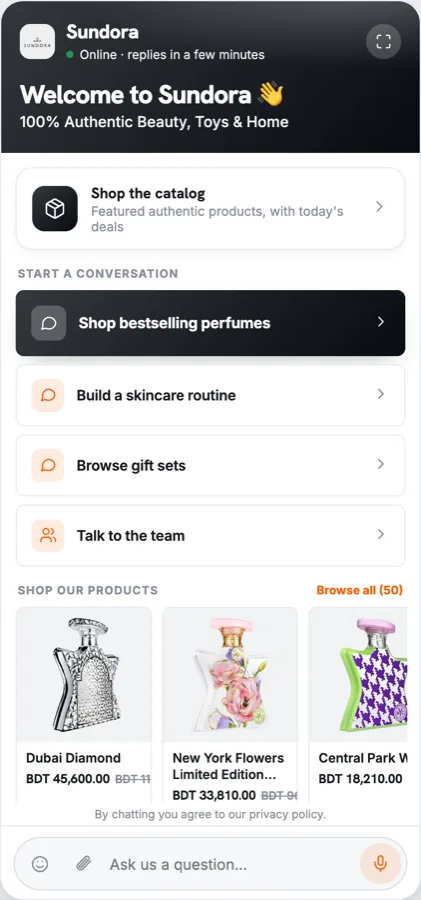 Sundora
 Glamgrl
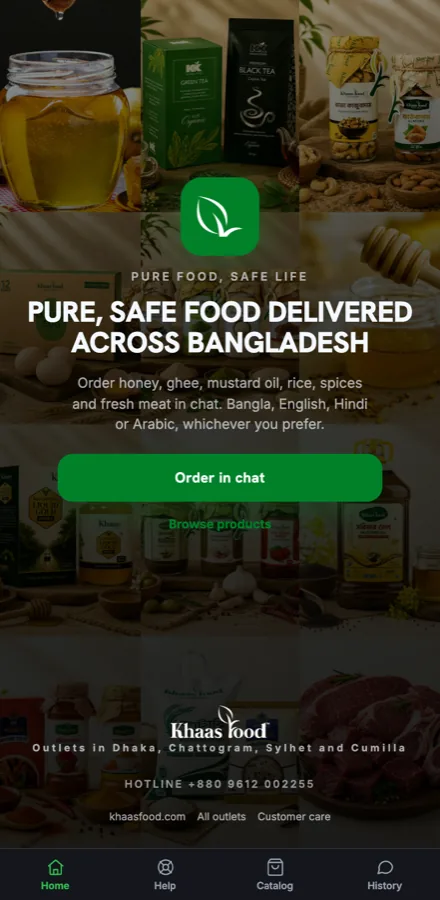 Khaas Food
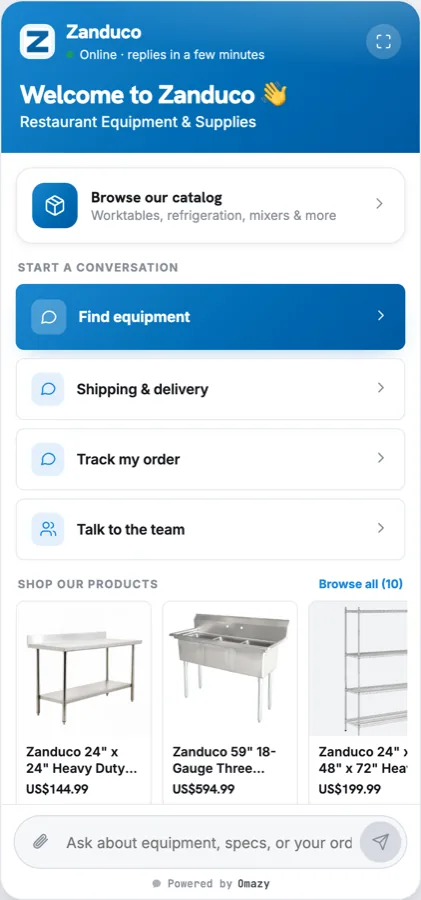 Zanduco